Over the last two decades, I have led service delivery organizations, managed services portfolios, and transformation programs for clients across banking & financial services, telecom, hi-tech, digital commerce, logistics, and utilities. During that time, I have witnessed several technology waves promise to transform the enterprise.
ERP transformed business operations.
Cloud transformed infrastructure.
Digital transformation reshaped customer experiences.
Today, AI is becoming the next defining shift.
The excitement is understandable. Nearly every leadership conversation I have today includes Copilots, AI agents, or intelligent automation. Organizations are investing heavily, experimenting rapidly, and looking for ways to unlock new levels of productivity and innovation.
Yet one question keeps coming back from CIOs and business leaders:
“We’ve launched several AI pilots. Why aren’t we seeing impact across the enterprise?”
In my experience, the technology is rarely the problem.
A couple of months ago, I wrote about how traditional managed services models are reaching their limits because modern technology is often being operated through service models designed for a different era. I see a similar pattern emerging within enterprises today.
Many organizations are trying to scale AI using operating models that were designed for a pre-AI world.
Where Pilots Stall
The pattern is familiar.
A business unit rolls out a Copilot. The service desk adds an AI assistant. Developers adopt AI-powered coding tools.
The early results are encouraging: faster response times, higher productivity, and improved user experiences.
Then the organization attempts to scale those successes, and progress begins to slow.
Questions start to emerge:
- Who owns AI across the enterprise?
- Which decisions should AI make, support, or influence?
- How will roles and responsibilities evolve?
- How will success be measured?
- What governance frameworks need to be in place?
These are not technology questions.
They are operating model questions.
Deploying AI can take weeks. Changing how an organization works takes considerably longer.
What I’ve Learned from Earlier Transformations
One of the most valuable lessons I’ve learned throughout my career is that technology rarely fails on its own.
More often, transformation efforts fall short because organizations underestimate the importance of people, governance, and operating model change.
I experienced this firsthand while leading a large-scale global transformation across multiple countries, where aligning stakeholders, processes, and accountability proved far more critical than the technology itself. The technology made the change possible, but the operating model made it sustainable.
That lesson has held true in most transformation programs I’ve been involved in.
The organizations that delivered lasting outcomes adapted their operating model alongside the technology. Those that stopped at implementation often struggled to realize the full value of their investment.
Today, I see the same pattern emerging with AI.
What I Mean by an AI-Powered Operating Model
When people hear the term AI-powered operating model, they often think about technology architecture.
I think about business design.
An AI-powered operating model describes how an organization operates when AI becomes part of the workforce and part of everyday decision-making.
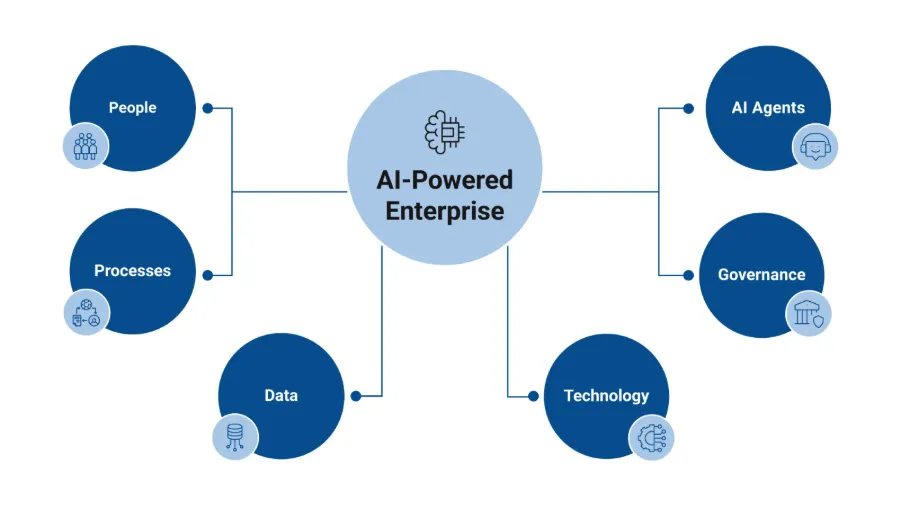
In my view, six dimensions need to evolve together:
People: Employees who are trained, empowered, and confident working alongside AI.
Processes: Workflows redesigned for automation and intelligence, not simply automated as they exist today.
Data: Information that is trusted, accessible, and properly governed.
Technology: AI capabilities integrated seamlessly into day-to-day operations and workflows.
Governance: Clear accountability for risk, compliance, security, ethics, and responsible AI adoption.
AI Agents: Intelligent systems that move beyond recommendations to executing tasks within defined guardrails.
When these dimensions evolve together, AI becomes an organizational capability rather than a collection of disconnected tools.
Human + AI, Not Human vs. AI
AI is often framed as an automation story.
I believe the bigger opportunity is augmentation.
The most successful transformations I’ve seen were never about replacing people. They were about enabling people to perform at a higher level.
As AI takes on repetitive and data-intensive tasks, people can spend more time on:
- Strategic thinking
- Innovation
- Customer engagement
- Relationship management
- Governance
- Complex decision-making
The future enterprise will not be built around Human versus AI.
It will be built around Human + AI.
Organizations that intentionally design for this partnership will unlock significant gains in productivity, agility, and innovation.
This Is a Leadership Agenda
AI cannot remain solely an IT initiative.
It is a leadership agenda.
As AI becomes embedded in business operations, leadership teams need to address questions such as:
- Which decisions should remain human-led?
- How will roles and responsibilities evolve?
- How do we govern AI responsibly and build trust?
- How do we measure value beyond productivity gains?
- How do we prepare our workforce for new ways of working?
The organizations making the most progress today treat AI as a transformation journey, not a technology deployment project.
Turning AI Ambition into Business Outcomes
At Saksoft, we’re increasingly working with organizations that have moved beyond asking whether they should invest in AI. Their focus has shifted to a more difficult question:
How do we scale AI while maintaining governance, trust, and measurable business outcomes?
Drawing on our experience across managed services, digital transformation, cloud, data, automation, and AI-enabled operations, we help organizations move from experimentation to enterprise adoption.
More recently, we have been applying these principles within the telecom sector, helping clients explore AI-enabled service operations aimed at improving productivity, shortening resolution times, enhancing employee experiences, and creating a foundation for scalable AI adoption.
What we’ve consistently observed is that successful AI adoption starts with the operating model. The organizations achieving the greatest value are those that address people, processes, governance, and accountability alongside technology implementation.
Our focus is on helping clients:
- Assess AI readiness and operating model maturity
- Design AI-enabled and Human + AI operating models
- Modernize service and support functions
- Embed AI into business and operational workflows
- Establish governance and risk frameworks
- Scale AI initiatives against measurable business outcomes
Our view is simple:
Success is not measured by how many AI tools an organization deploys. It is measured by how effectively AI becomes part of the way the organization operates and creates value.
Closing Thoughts
Every technology shifts I’ve worked through has taught me the same lesson:
Technology creates possibility. Operating models determine outcomes.
I don’t believe AI will be any different.
The organizations that lead the next decade won’t simply be AI-enabled.
They’ll be AI-powered.
And that distinction won’t be determined by the sophistication of their AI technology. It will be determined by the strength of the operating model behind it.
So, the question I’d put to any leadership team is not:
“How fast can we deploy AI?”
But rather:
“Is our organization ready to operate in an AI-powered world?”
Because AI alone doesn’t transform enterprises. Operating models do.
Move from AI Pilots to Enterprise Impact
Scaling AI takes more than deploying another Copilot or agent. Discover how Saksoft helps enterprises align people, processes, data, and governance to deliver measurable business outcomes.
Explore Saksoft’s AI Capabilities
Ready to evaluate your AI maturity? Schedule a strategy conversation with our team.