Enterprise AI is already here — and it’s scaling faster than most organizations expected. The conversation has moved on. The question is no longer whether to adopt AI. It’s whether your operations can actually sustain it.

The Gap Nobody Wants to Talk About

Look beneath the surface of most enterprise AI programmes, and you’ll find a telling pattern. The investment is there. The tools are deployed. The use cases are live and generating value. But ask operations teams how it actually feels to run these systems every day — across multi-cloud platforms, distributed infrastructure, hybrid environments, and continuous release cycles — and the story changes quickly.

The underlying operations model wasn’t designed for this world. It was built for environments that were more predictable, more contained, and far easier to manage. Today’s enterprise infrastructure is none of those things.

Building AI is no longer the hard part. Running it — reliably, consistently, and at scale — is where the real work begins.

Every layer of modern infrastructure is generating signals — logs, metrics, events, traces — at a volume no human team can realistically process in real time. And yet operations teams are still expected to monitor dashboards, investigate alerts, and resolve issues in the same way they always have. That gap between the scale of the environment and the way we operate it is where real business risk quietly accumulates.

Why the Traditional Model Is Breaking

The traditional IT operations model is elegantly simple:

Monitor → Detect → Fix

For a long time, that was enough. The environment was relatively stable. The incidents were infrequent. Human response times were acceptable. But in a world where infrastructure is always-on, always-distributed, and always-changing, this model has a fundamental flaw: by the time you detect an issue and respond, the impact has already reached the business.

Customers have noticed the degradation. Transactions have slowed. A service has gone dark. In sectors like banking, logistics, and SaaS — where even small disruptions can cascade rapidly — that’s not just a technical problem. It’s a revenue problem, a compliance problem, and a trust problem.

The expectation has fundamentally shifted. We don’t just need to react faster. We need to anticipate earlier — and act with intelligence, not just instinct.

What AIOps Actually Changes

AIOps is widely misunderstood. Many organizations treat it as a more sophisticated automation layer — a way to script more responses, trigger more runbooks, close more tickets without human touch. That’s not wrong, but it’s incomplete.

At its core, AIOps introduces something far more fundamental: intelligence into operations. It treats infrastructure not as something to be watched and fixed, but as a system that can learn — one that understands patterns, identifies anomalies before they become incidents, predicts failures before they reach customers, and takes action at a speed and scale no human team can match.

The shift it enables is from a reactive function to a continuous learning system. And that changes the conversation entirely.
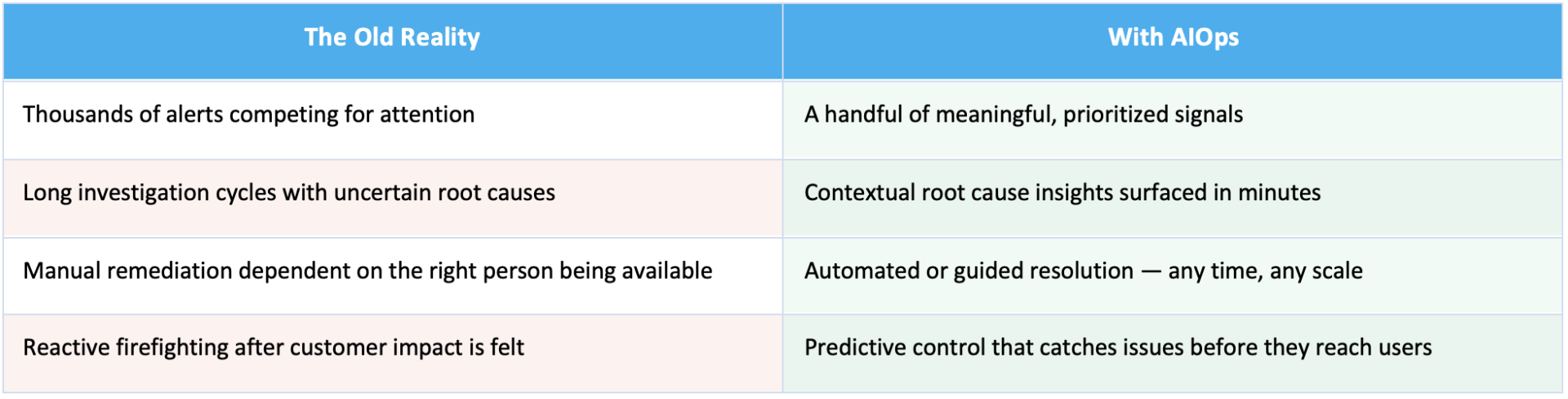
The Three Outcomes That Matter

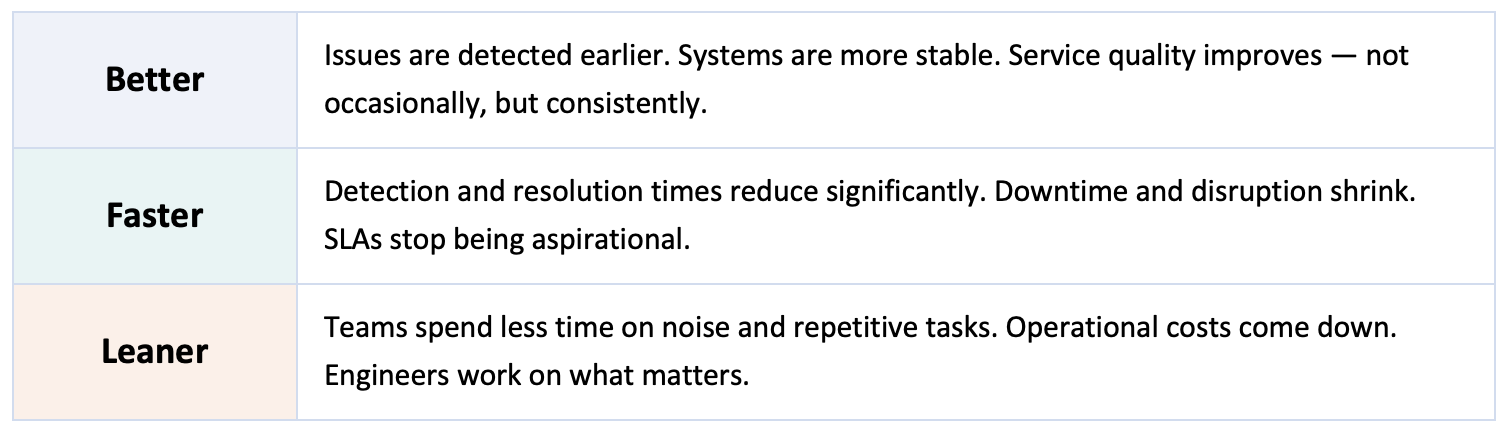
When AIOps is embedded effectively, the operational impact becomes tangible and measurable across three dimensions:
Enterprise AI is already here — and it's scaling faster than most organizations expected. The conversation has moved on. The question is no longer whether to adopt AI. It's whether your operations can actually sustain it.

The Gap Nobody Wants to Talk About
Look beneath the surface of most enterprise AI programmes, and you'll find a telling pattern. The investment is there. The tools are deployed. The use cases are live and generating value. But ask operations teams how it actually feels to run these systems every day — across multi-cloud platforms, distributed infrastructure, hybrid environments, and continuous release cycles — and the story changes quickly.

The underlying operations model wasn't designed for this world. It was built for environments that were more predictable, more contained, and far easier to manage. Today's enterprise infrastructure is none of those things.

Building AI is no longer the hard part. Running it — reliably, consistently, and at scale — is where the real work begins.
 Every layer of modern infrastructure is generating signals — logs, metrics, events, traces — at a volume no human team can realistically process in real time. And yet operations teams are still expected to monitor dashboards, investigate alerts, and resolve issues in the same way they always have. That gap between the scale of the environment and the way we operate it is where real business risk quietly accumulates.

Why the Traditional Model Is Breaking
The traditional IT operations model is elegantly simple:

 Monitor → Detect → Fix

 For a long time, that was enough. The environment was relatively stable. The incidents were infrequent. Human response times were acceptable. But in a world where infrastructure is always-on, always-distributed, and always-changing, this model has a fundamental flaw: by the time you detect an issue and respond, the impact has already reached the business.

 Customers have noticed the degradation. Transactions have slowed. A service has gone dark. In sectors like banking, logistics, and SaaS — where even small disruptions can cascade rapidly — that's not just a technical problem. It's a revenue problem, a compliance problem, and a trust problem.

 The expectation has fundamentally shifted. We don't just need to react faster. We need to anticipate earlier — and act with intelligence, not just instinct.

What AIOps Actually Changes
AIOps is widely misunderstood. Many organizations treat it as a more sophisticated automation layer — a way to script more responses, trigger more runbooks, close more tickets without human touch. That's not wrong, but it's incomplete.

 At its core, AIOps introduces something far more fundamental: intelligence into operations. It treats infrastructure not as something to be watched and fixed, but as a system that can learn — one that understands patterns, identifies anomalies before they become incidents, predicts failures before they reach customers, and takes action at a speed and scale no human team can match.

 The shift it enables is from a reactive function to a continuous learning system. And that changes the conversation entirely.

Article content
The Three Outcomes That Matter
When AIOps is embedded effectively, the operational impact becomes tangible and measurable across three dimensions:

Article content
This is the point at which AI stops being a feature bolted onto operations — and becomes the core engine that operations run on.

Infrastructure Is No Longer a Backend Concern
Something important has shifted in how leadership thinks about infrastructure. For most of the last decade, it sat in the background — a cost center to be managed, a capability to be maintained, a function that only showed up in board conversations when something went wrong.

That's no longer the case. Infrastructure now sits directly in the path of:

→ Customer experience — the quality of every digital interaction

→ Revenue continuity — the stability of every transaction and workflow

→ Regulatory compliance — the integrity of every data process

→ Brand trust — the reliability every customer takes for granted

 In this context, the ability to maintain operational stability isn't a technical goal. It's a business requirement — one that belongs in the same strategic conversation as product, growth, and risk.

The next phase of digital transformation will not be defined by how much AI organizations adopt. It will be defined by how well they run it.
A Quiet but Important Shift in Measurement
Perhaps the most telling indicator of this change is how progressive organizations are beginning to measure operations. The old metrics were effort-based: tickets closed, incidents resolved, time to respond. They measured activity, not impact.

The new metrics are outcome-based:

1. Continuity — how consistently services remain available

2. Reliability — how predictably systems perform under load

3. Experience — how operations translate into customer satisfaction

4. Value — how operational performance connects to business outcomes 

This shift in measurement naturally points toward AIOps. Because you cannot deliver outcome-driven operations without intelligence embedded into the system. Effort-based operations can achieve effort-based outcomes. Intelligence-driven operations are the only path to business-level outcomes.

The Real Opportunity
The opportunity here is not simply to implement smarter tooling. It's far broader than that.

 It is the opportunity to help organizations fundamentally rethink how operations are designed — to move from a model built around managing infrastructure to one built around running intelligent systems. That requires:

→ Embedding intelligence into infrastructure and cloud operations from the ground up

→ Building observability foundations that are comprehensive, not just checkbox-compliant

→ Enabling automation that is contextual and adaptive — not just scripted responses to known events

→ Aligning operational performance directly with the business outcomes it exists to enable

This is where the role of the operations partner evolves from service provider to transformation partner — from keeping the lights on to actively driving business resilience.

Closing Perspective
AI will continue to advance. Cloud environments will become more distributed. Applications will grow more complex. The pace of change will not slow.

 But through all of it, one thing will separate the organizations that thrive from those that struggle: 

How reliably everything runs — every single day.
 That's why AIOps is not just another capability to evaluate. It is becoming the intelligence layer that modern infrastructure depends on — and the foundation on which the next generation of digital enterprise will be built.
This is the point at which AI stops being a feature bolted onto operations — and becomes the core engine that operations run on.

Infrastructure Is No Longer a Backend Concern

Something important has shifted in how leadership thinks about infrastructure. For most of the last decade, it sat in the background — a cost center to be managed, a capability to be maintained, a function that only showed up in board conversations when something went wrong.

That’s no longer the case. Infrastructure now sits directly in the path of:

→ Customer experience — the quality of every digital interaction
→ Revenue continuity — the stability of every transaction and workflow
→ Regulatory compliance — the integrity of every data process
→ Brand trust — the reliability every customer takes for granted

In this context, the ability to maintain operational stability isn’t a technical goal. It’s a business requirement — one that belongs in the same strategic conversation as product, growth, and risk.

The next phase of digital transformation will not be defined by how much AI organizations adopt. It will be defined by how well they run it.

A Quiet but Important Shift in Measurement

Perhaps the most telling indicator of this change is how progressive organizations are beginning to measure operations. The old metrics were effort-based: tickets closed, incidents resolved, time to respond. They measured activity, not impact.

The new metrics are outcome-based:

1. Continuity — how consistently services remain available
2. Reliability — how predictably systems perform under load
3. Experience — how operations translate into customer satisfaction
4. Value — how operational performance connects to business outcomes

This shift in measurement naturally points toward AIOps. Because you cannot deliver outcome-driven operations without intelligence embedded into the system. Effort-based operations can achieve effort-based outcomes. Intelligence-driven operations are the only path to business-level outcomes.

The Real Opportunity

The opportunity here is not simply to implement smarter tooling. It’s far broader than that.

It is the opportunity to help organizations fundamentally rethink how operations are designed — to move from a model built around managing infrastructure to one built around running intelligent systems. That requires:

→ Embedding intelligence into infrastructure and cloud operations from the ground up
→ Building observability foundations that are comprehensive, not just checkbox-compliant
→ Enabling automation that is contextual and adaptive — not just scripted responses to known events
→ Aligning operational performance directly with the business outcomes it exists to enable

This is where the role of the operations partner evolves from service provider to transformation partner — from keeping the lights on to actively driving business resilience.

Closing Perspective

AI will continue to advance. Cloud environments will become more distributed. Applications will grow more complex. The pace of change will not slow.

But through all of it, one thing will separate the organizations that thrive from those that struggle:

How reliably everything runs — every single day.

That’s why AIOps is not just another capability to evaluate. It is becoming the intelligence layer that modern infrastructure depends on — and the foundation on which the next generation of digital enterprise will be built.