The enterprise AI mandate has shifted. Boards are no longer asking if AI can generate insights or automate tasks. The question has become more fundamental: Can we scale AI sustainably—without compounding architectural risk, cost volatility, and governance exposure?
Across industries, organizations have accelerated experimentation, particularly in Generative AI. Yet, a common pattern is emerging. Recent data suggests a significant volume of GenAI initiatives fail to progress beyond Proof of Concept (PoC) due to data quality gaps, spiralling operational costs, and integration complexity.
The issue is not ambition. It is execution discipline.
The Rise of AI Technical Debt
As AI initiatives proliferate—marketing copilots, automated analytics, and internal assistants—enterprises are unknowingly accumulating AI Technical Debt. Unlike traditional technical debt, which builds gradually through deferred modernization, AI debt compounds at an exponential rate:
- Fragmentation: Multiple disconnected models solving redundant problems.
- Isolation: Copilots deployed without enterprise integration standards.
- Stagnation: Data silos limiting model performance and context.
- Volatility: Infrastructure costs scaling unpredictably.
- Lag: Governance frameworks trailing behind rapid experimentation.
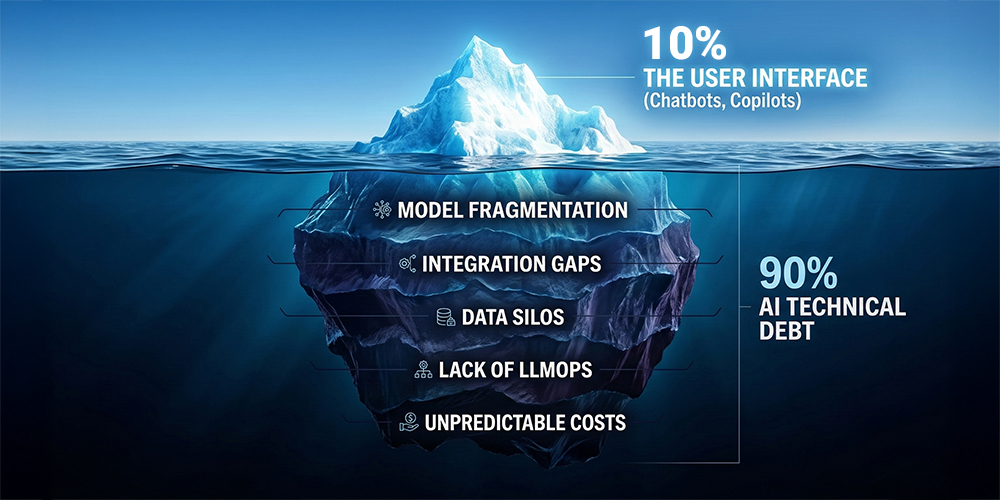
Without a structured approach, innovation velocity unintentionally creates enterprise fragility. The path forward is not to slow down—but to institutionalize.
The AI Innovation Lab: From Sandbox to Factory
An AI Innovation Lab is often misunderstood as a "sandbox" for pilots. At scale, its purpose must evolve into a strategic operating mechanism designed to industrialize AI adoption.
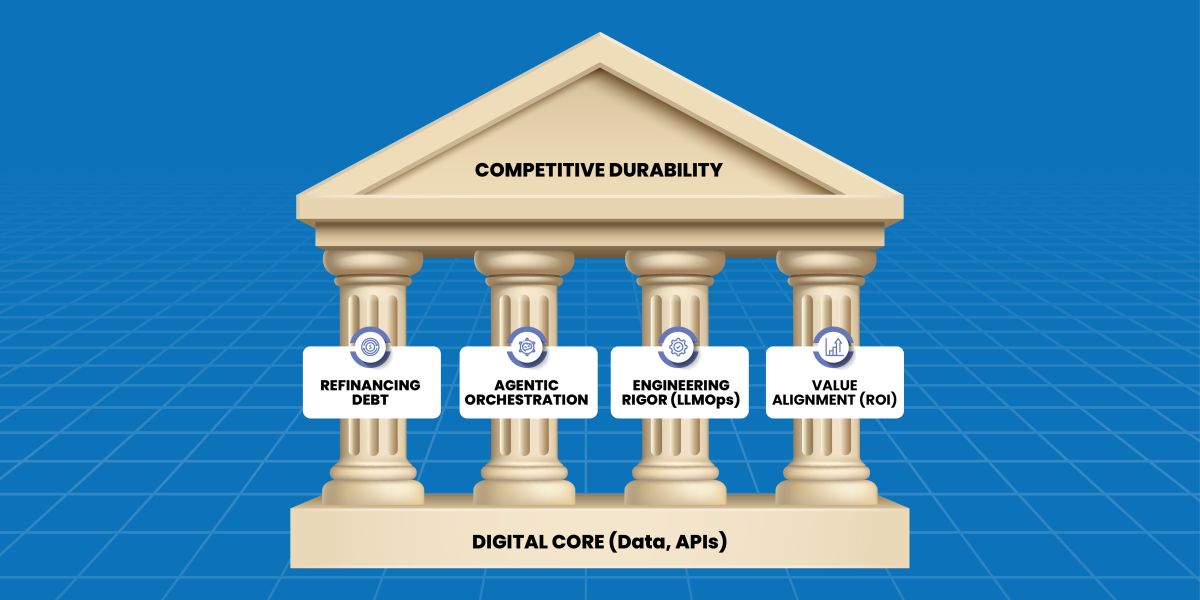
A high-performing Lab charter focuses on four critical pillars:
- Refinancing AI Technical Debt: Modernizing the digital core (APIs, data architecture, and integration layers) so AI builds on a stable foundation rather than bypassing it.
- Agentic Orchestration: Moving beyond isolated chat interfaces toward intelligent, multi-step workflows capable of reasoning and system-level coordination.
- Engineering Rigor: Embedding LLMOps, model lifecycle management, and observability to ensure AI systems are secure, explainable, and sustainable.
- Value-Stream Alignment: Prioritizing AI investments against measurable outcomes—revenue growth, operational efficiency, and risk mitigation.
Why "Joint" Matters: Co-Engineering Scale
AI transformation cannot be effectively outsourced in a vacuum, nor can it succeed in a centralized "innovation tower" disconnected from core operations.
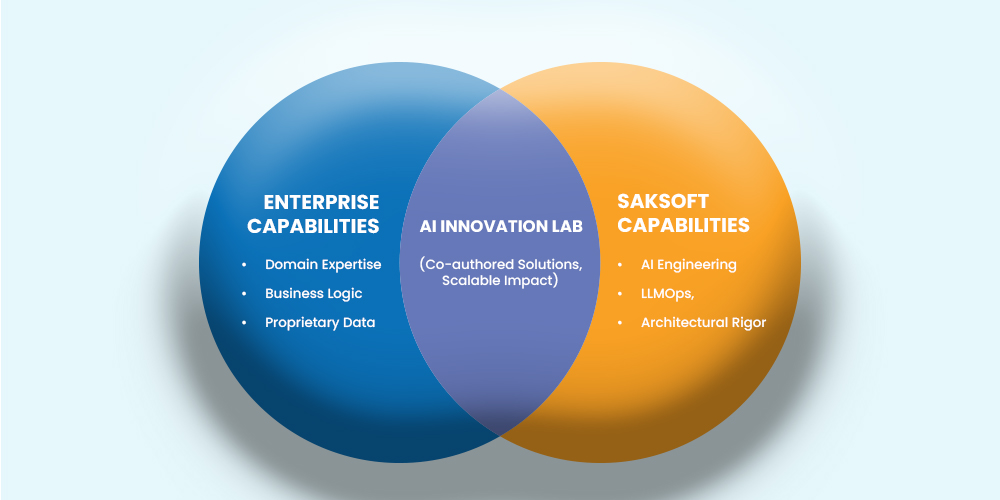
A Joint AI Innovation Lab integrates enterprise domain experts with specialized AI engineering capabilities into a unified execution squad. This collaborative model ensures:
- Alignment: Business and technology goals are synchronized from Day 1.
- Shared Skin in the Game: KPIs are linked to measurable production outcomes, not just "successful pilots."
- Consistency: Architectural standards are maintained across all business units.
- Embedded Governance: Security and compliance are built into the code, not retrofitted as an afterthought.
The "joint" model mitigates the most common cause of AI stagnation: the disconnect between strategic ambition and engineering execution.
A Structured Execution Roadmap
To convert strategy into scalable impact, the Joint AI Innovation Lab follows a disciplined five-stage methodology:
Readiness & Debt Assessment: Evaluate the digital core and identify where AI might strain existing architecture.
Value-Stream Prioritization: Map high-impact use cases to enterprise value streams to avoid "random acts of digital."
Platform-First Engineering: Standardize integration frameworks and embed LLMOps for production readiness.
Agentic Workflow Deployment: Design workflows that move beyond static assistants to autonomous, reasoning systems.
Continuous Refinement: Monitor cost-to-value ratios and compliance posture to iterate responsibly.
From Pilots to Platforms
The enterprises that lead the next decade will not be those that experimented first. They will be those that institutionalized AI governance, standardized their engineering practices, and built reusable platforms.
In this context, a Joint AI Innovation Lab becomes more than a center for ideas—it becomes a mechanism for competitive durability.
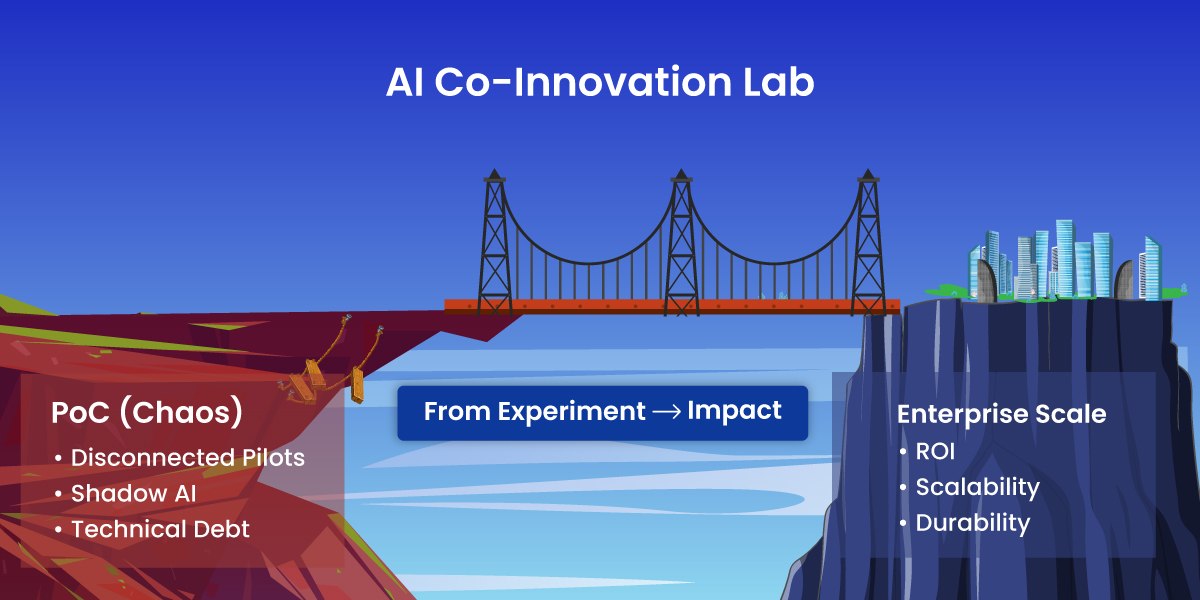
A leading global technology distribution enterprise partnered with Saksoft to establish a Joint AI Innovation Lab to move beyond isolated AI pilots and enable scalable adoption. Built on a co-innovation and Build-Operate-Transfer model, the lab combined domain expertise with structured AI engineering, governance, and reusable platforms.
This approach accelerated production-ready use cases while embedding architectural rigor and measurable value alignment. The initiative ultimately shifted AI from experimentation to a sustainable, enterprise-grade operating model driving continuous innovation.
Defining Your AI Operating Model
The question for executive leadership is straightforward: Are we building scalable AI assets, or are we accumulating AI complexity?
Saksoft partners with enterprises to design and operationalize Joint AI Innovation Labs that balance rapid innovation with rigorous engineering discipline. Our objective is not just "more pilots," but a resilient AI operating model aligned to your specific business outcomes.
At Saksoft, our goal is to help you set up this collaborative engine—turning the "AI Debt" crisis into a "Value Stream" opportunity. Let's stop experimenting and start scaling.