For large organizations battling ever-growing volumes of customer queries, internal operations, field service requests, and repetitive admin tasks, AI-based automation is becoming a strategic lever. Yet behind the confident vision statements and slick demos lies a hard truth: many enterprises are failing to get AI into production.
Companies are spending millions on models, infrastructure and pilots, only to watch them stall. This is the tension Salesforce leaned into at Agentforce World Tour London 2025. The company didn’t just showcase product roadmaps; it held a mirror to the industry.
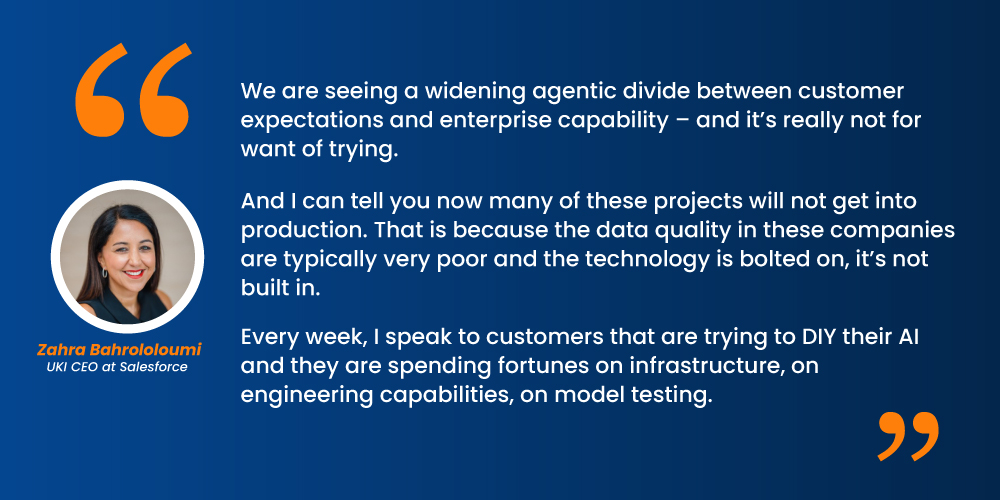
At the 2025 Agentforce World Tour in London, Salesforce intensified its message around “agentic AI,” highlighting its unique capability to meet the complex AI demands of large organizations. Instead of selling more AI, the company is building the data foundation AI requires — from Agentforce 360 to Data 360 as the core layer of truth. The $8 billion acquisition of Informatica is not a side bet either; it is the structural piece that expands the universe of data Salesforce can harmonize, unify, and activate.
As Marc Benioff put it: data is the first layer of a $10 billion business, and without harmonization, reliability, and context, AI cannot perform. This is why pricing, governance, and flexibility suddenly matter so much.
Moving Beyond the “$2 Conversation” Model
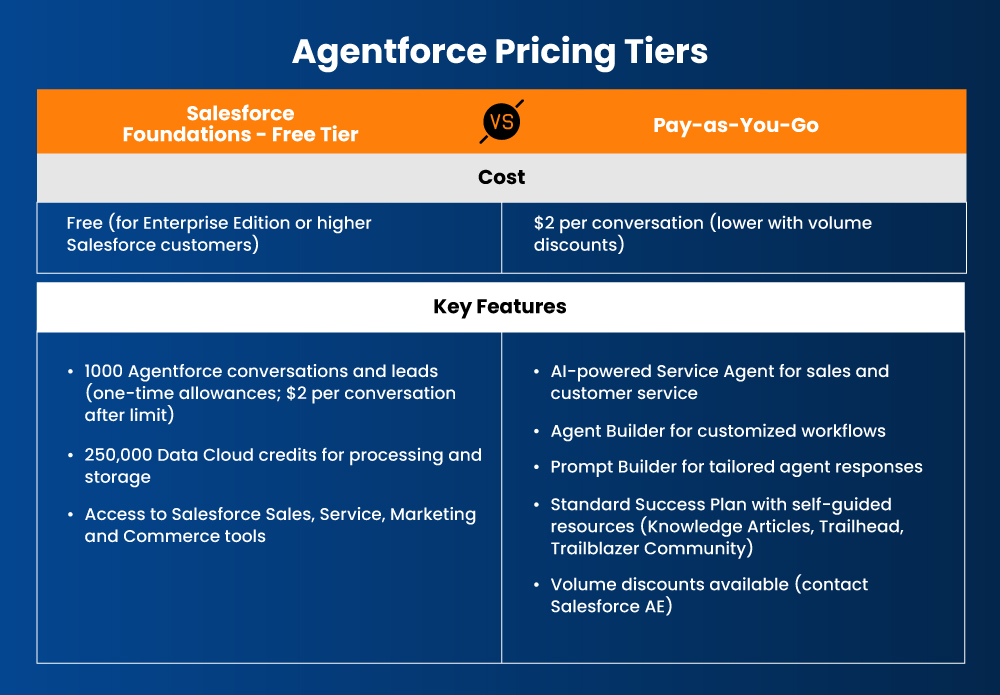
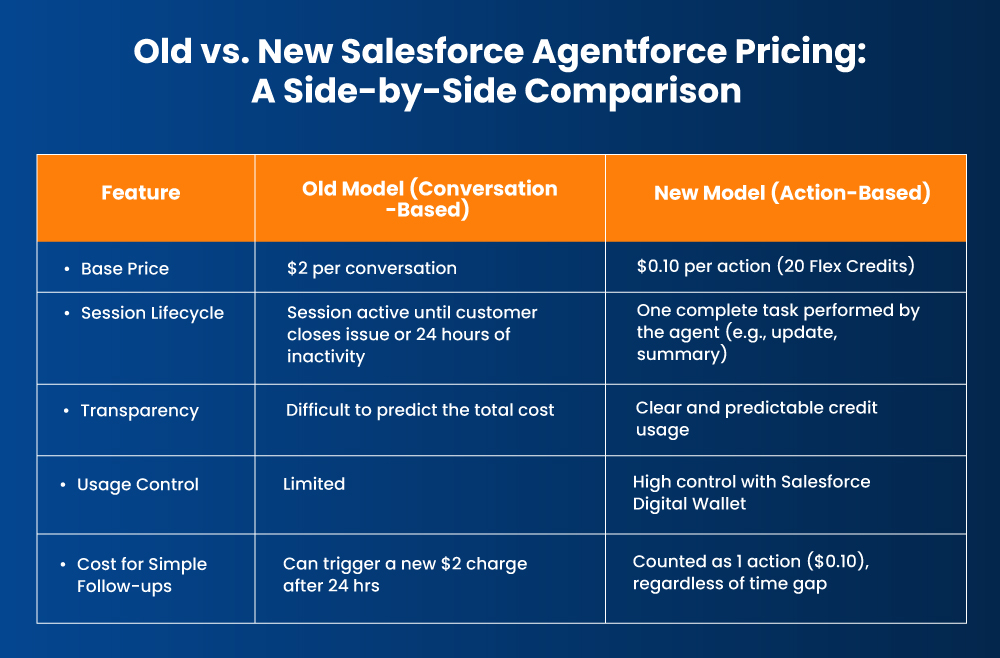
When Agentforce was first launched, its pricing was a simple US$2 per conversation (per 24-hour chat window) — a straightforward model for early pilots or customer-chat use cases.
However, this model proved problematic: “conversations” could branch, linger, and not necessarily reflect meaningful business value. A long chat could cost the same as a quick query. This lack of alignment between cost and outcome made budgeting difficult and inhibited large-scale adoption.
Leaders reported that the pricing was neither predictable nor aligned with business value. One support organization calculated that a team of five agents, each handling around 70 conversations per day, would face roughly $900 in daily spend. In a world where budgets are scrutinized monthly, this was a non-starter. This uncertainty created a market opening for competing solutions that offered either granular consumption metrics or fixed, predictable pricing. In other words, Salesforce wasn’t losing because of its capability; it was losing because of economics.
What Changed? A Clearer, More Flexible Pricing Model
In May 2025, Salesforce officially revamped Agentforce pricing with multiple consumption and subscription options, allowing enterprises to match cost with value.
1. Flex Credits (Action-Based, Metered)
Flex Credits introduce a pay-per-action model, where each agent action (e.g., updating a record, resolving a case, scheduling, summarization, RAG lookup) costs 20 Flex Credits.
-
-
- 100,000 Flex Credits = $500
- 1 action = $0.10
-
Flex Credits can be purchased in three ways:
-
- Pre-commit (upfront payment)
- Pre-commit on usage (no upfront payment)
- Pure consumption-based (pay as you go)
All Flex Credit models are metered, tracked in real time via the Salesforce Digital Wallet, enabling predictable forecasting and cost control.
2 User-Based Agentforce Licenses (Unmetered)
For employee-facing AI and internal workflows, Salesforce introduced per-user-per-month (PUPM) licensing:
- Agentforce Editions: $550 PUPM (unmetered)
- Agentforce Add-on for standard clouds (Sales, Service, etc.): $125 PUPM (unmetered)
- Agentforce Add-on for Industry Clouds: $150 PUPM (unmetered)
These models allow unlimited internal agent usage, making them ideal for HR, finance, IT, and internal operations where predictability matters more than granular metering.
Additionally:
- Employee / platform user licenses start at $5 PUPM, but are metered and limited, suitable for lighter use cases.
3. Data Credits for RAG and Unstructured Data
Data Credits are now a critical part of the pricing conversation. These are used within Data Cloud for:
- Unstructured data processing
- Retrieval-Augmented Generation (RAG)
- Document ingestion, vectorization, and semantic search
P.S. AI agents are only as good as the data they can reason over, and Data Credits power that intelligence layer.
4. Salesforce Foundations: Free Starting Point
Salesforce now provides Salesforce Foundations at $0 to all Enterprise Edition and above customers. This includes:
- 100,000 Flex Credits (free)
- Free Data Cloud provisioning
- Included Data Credits (allocation varies by edition)
This lowers the barrier to entry and allows enterprises to experiment before committing large-scale spending.
5. Agentforce Studio: Governance and Observability Built In
Agentforce Studio now ships with:
- Agent Testing Center (free) for pre-production validation
- Digital Wallet for usage monitoring
- Built-in analytics to track agent actions, performance, and outcomes
This directly addresses enterprise concerns around governance, observability, and ROI measurement.
Additional Announcements:
- Flex Agreement: a flexible licensing arrangement that allows organizations to shift budget between human user licenses and digital labor — converting user licenses into Flex Credits and vice versa. This gives enterprises agility to allocate spend as needs fluctuate.
In short: enterprises can now choose between per-action billing, fixed user-based billing, or a hybrid, depending on their use case and maturity level. This represents a fundamental shift in how enterprises think about deploying AI at scale.
Internal vs. External Interactions
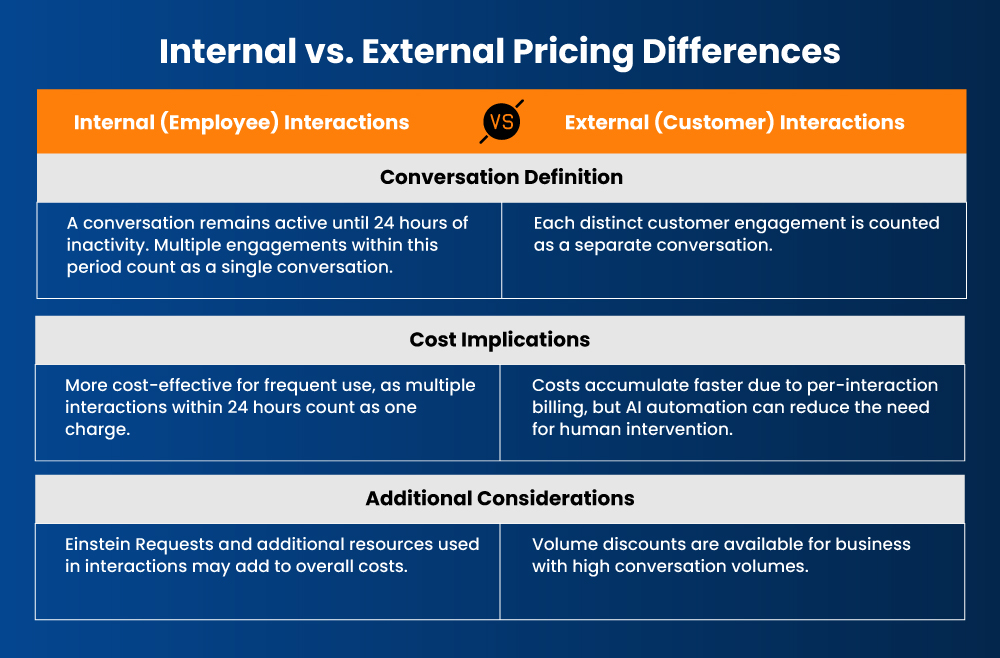
One of the strengths of the new pricing and licensing is the differentiation between internal (employee-facing) use and external (customer-facing) use.
- Internal use (e.g. HR onboarding, internal ticket automation, knowledge-base querying, internal workflows) can be covered through per-user license add-ons or bundled packages. This offers predictable cost per employee, and encourages widespread adoption without constant per-action monitoring.
- External use (customer support, service agents, field-service workflows, customer-facing bots) still often relies on action-based consumption (Flex Credits) or the legacy conversation model. This aligns cost with actual customer interactions and outcomes, instead of idle or trivial chat sessions.
This split is meaningful: enterprises wanting to automate internal operations at scale might find user-based models efficient, while those automating customer interactions benefit from pay-per-action transparency.
How to Measure ROI for Your Agentforce Investment
If you’re investing in Agentforce, measuring ROI requires more than just watching usage. Consider:
- Cost per action vs. cost per conversation — Compare what you spend (via Flex Credits or license fees) against what you achieve (cases resolved, workflows automated, time saved, reduction in human labor).
- Volume of agent actions over time — As adoption scales, cost-per-use tends to decrease while value delivered increases (economies of scale).
- Efficiency gains — Time saved by employees, faster response times, reduced ticket backlogs, fewer manual processes, improved customer satisfaction.
- Avoided costs — Lower error rates, fewer escalations, faster SLA compliance, better customer retention.
- Flexibility and scalability — The ability to scale up/down without renegotiating large contracts can reduce wasted spend.
In essence: ROI isn’t just about “did we save money,” but also “are we getting better outcomes for what we spent.”
The Underlying Challenge: Data Readiness
All the flexibility and pricing nuances in the world won’t compensate for a poor data foundation. AI agents live and breathe data i.e. internal records, customer histories, product catalogs, workflows. If data is siloed, outdated, or inconsistent, you’ll end up with agents that produce incorrect, incomplete, or even misleading results.
Therefore, data readiness is arguably the biggest (and most often ignored) gatekeeper to successful Agentforce deployment. Before scaling up, enterprises must invest in data integration, cleaning, normalization, and governance frameworks. Without that, even well-priced agents are wasted spend.
Conclusion
The revamp of Agentforce pricing represents a major inflection point. For large enterprises ready to treat AI as “digital labor,” this unlocks the possibility of scaling across departments, workflows, and use cases, without the budgetary uncertainty of old models.
But with that flexibility comes responsibility. Enterprises must think beyond just “turning on AI.” They must ask: Do we have the right data foundation? Do we have governance and observability in place? Can we forecast usage and measure ROI?
When done right, Agentforce becomes more than a chatbot or ticket-solver; it becomes a force multiplier for human teams: smarter, faster, more efficient. For those willing to invest in data maturity, governance, and long-term strategic thinking, this could indeed be a power move.