
About The Client
A leading North American logistics and expedited ground transportation provider, delivering scheduled, time-definite surface transportation as a cost-effective alternative to air freight.
Challenges
Following a major acquisition, the organization operated across two separate cloud ecosystems — one built on AWS and the other on Microsoft Azure technologies. This resulted in:
Dual cloud architectures operating in parallel
Separate AWS and Azure environments led to duplicated ingestion, transformation, and reporting pipelines.No unified view of business performance
Data silos prevented consistent reporting across the newly combined organisation.Data quality and ETL gaps impacting reporting accuracy
Inefficiencies in ETL processes led to issues such as overstated revenue and unreliable business insights.High operational costs across fragmented platforms
Spend increased across AWS and MS Fabric, which was underutilized and restricted primarily to Power BI without a Data Lakehouse.Limited scalability for future initiatives
Fragmentation restricted the ability to implement enterprise-wide analytics and AI capabilities.
Solutions
To address these challenges, the organization undertook a full-scale consolidation of its multi-cloud architecture into a single, unified data platform built on Microsoft Fabric.
The approach focused on standardizing data architecture, eliminating duplication, and aligning both legacy environments into one cohesive, enterprise-wide data eco-system.
Consolidated multi-cloud environments into Microsoft Fabric
AWS-based data workloads were rationalized and migrated into a Fabric-centric architecture, aligning both organizations onto a single platform.Standardized architecture using a medallion model
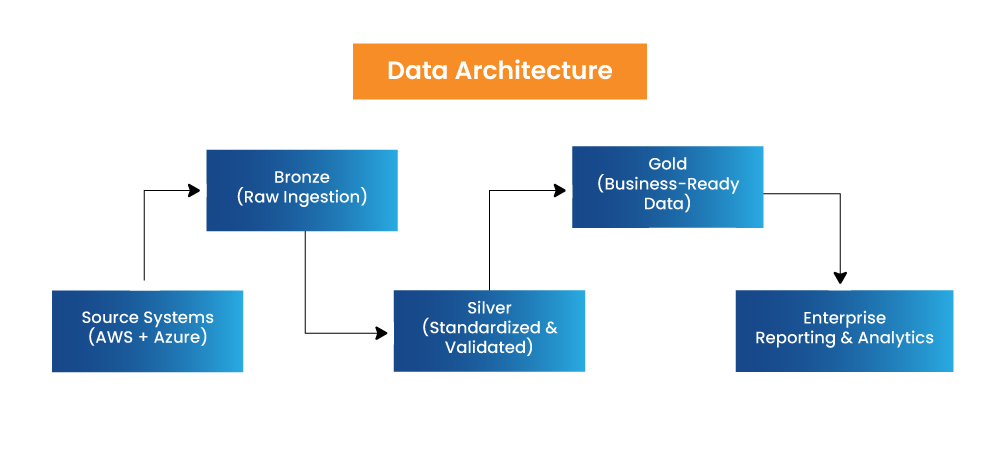
A Bronze, Silver, and Gold data layering approach was implemented to ensure consistency, quality, and scalability across all data assets.Unified ingestion, transformation & near real-time reporting
Streamlined pipelines into governed frameworks and leveraged Mirror DB for near real-time data synchronization and reporting.Flexible data model for incremental onboarding
Designed a consolidated, extensible data model to support gradual onboarding of TMS and other enterprise data sources.Integrated Databricks for advanced analytics
Existing Databricks capabilities were retained and integrated into the Fabric ecosystem, enabling advanced analytics and future AI/ML use cases.Established a single source of truth
A centralized data foundation was created to support consistent reporting, cross-functional analytics, and executive decision-making.
Data Architecture
Outcomes
A unified platform driving efficiency, visibility, and future readiness
The consolidation delivered immediate operational and strategic benefits, transforming how the organization accesses and leverages its data.
Cost-Savings: Fully leveraged existing cloud licenses to reduce infrastructure cost by over 30%
Near real-time, accurate reporting for decision-making Enabled near real-time reporting with standardized KPIs and measures, improving operational visibility and business decisions.
Data Federation: Enabled cross-organizational access without compromising security
Enterprise-wide visibility Leadership now has access to a single, consistent view of performance across the combined business.
Operational efficiency Simplified data pipelines and reduced duplication improved speed, reliability, and maintainability.
Scalable foundation for growth A unified Fabric-based platform enables advanced analytics, self-service reporting, and AI/ML at scale.
Post-acquisition integration Successfully aligned two previously independent data ecosystems into one cohesive, enterprise data program.
This transformation brought together previously siloed environments into one cohesive, client-wide program — simplifying the data landscape, reducing redundancy, and enabling consistent, scalable analytics across the combined business.
Related Case Study